Sudden Net-Zero (SNZ) CZ gate
The Sudden Net-Zero (SNZ) pulse [21] implements a CZ gate between two flux-tunable transmons. As in the Net-Zero scheme [29], two square half-pulses of opposite sign (\(\pm A\)) bring the pair to the \(\ket{11} \leftrightarrow \ket{02}\) avoided crossing, making the pulse robust to long-timescale flux distortions. SNZ adds a single edge sample \(\pm B\) to each half and an idling time \(t_\text{idle}\) between them.
The pulse shape is shown below for \(t_\text{idle} = 4\) samples and \(B/A = 0.36\). Each square half-pulse lasts \(\tau\) samples, so that the gate time is \(t_p = 2\tau + 2\) samples and the total duration is \(t_p + t_\text{idle}\).
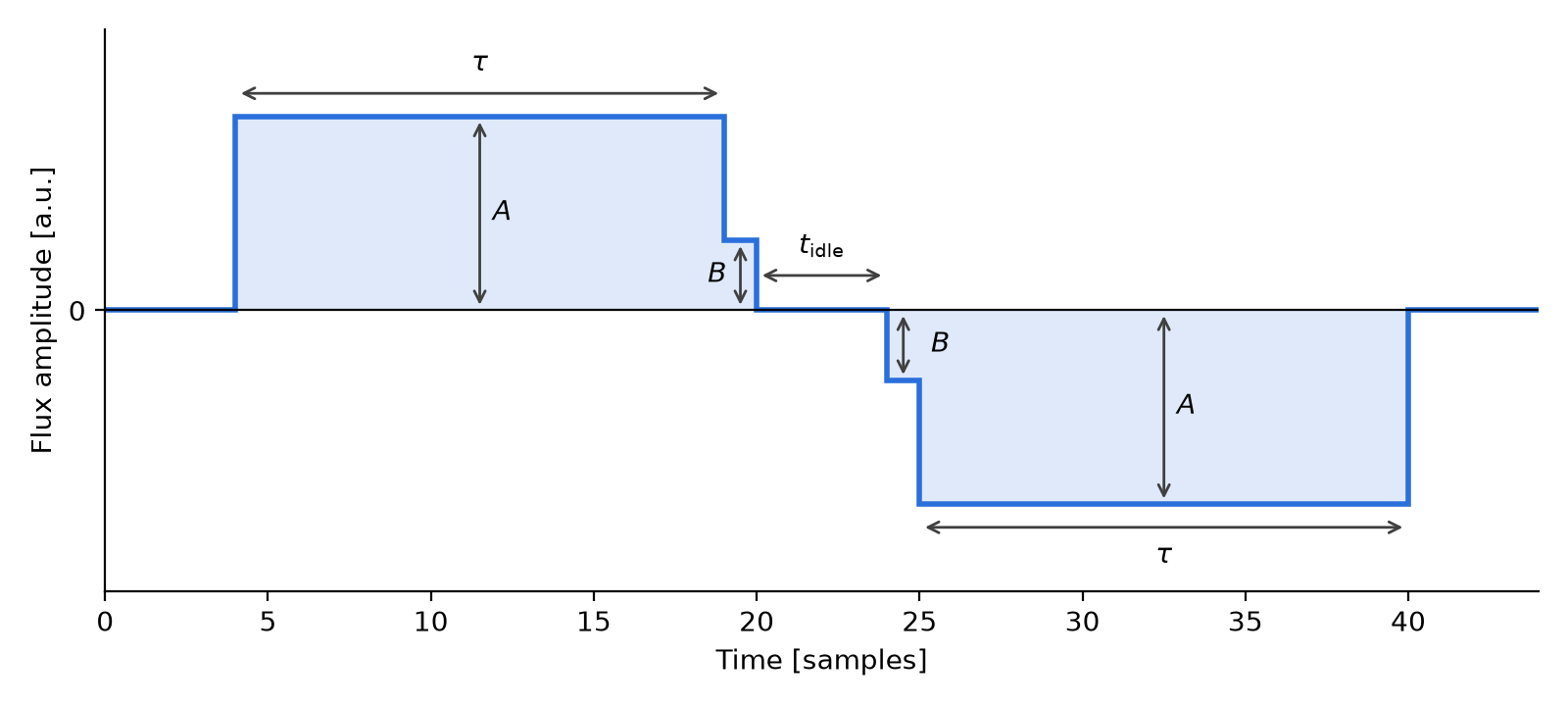
Population leaked to \(\ket{02}\) by the first half-pulse returns to \(\ket{11}\) during the second one if the relative phase accumulated in between is right. Since \(t_\text{idle}\) is discretized by the flux AWG sampling rate \(t_s\), it changes this phase only in coarse steps of \(\Delta_{02} t_s\), where \(\Delta_{02}\) is the detuning of \(\ket{02}\) during the idling (typically \(\Delta_{02}/2\pi \sim\) 0.5-1 GHz and \(t_s \sim\) 1 ns). The \(\pm B\) samples provide the fine, continuous control.
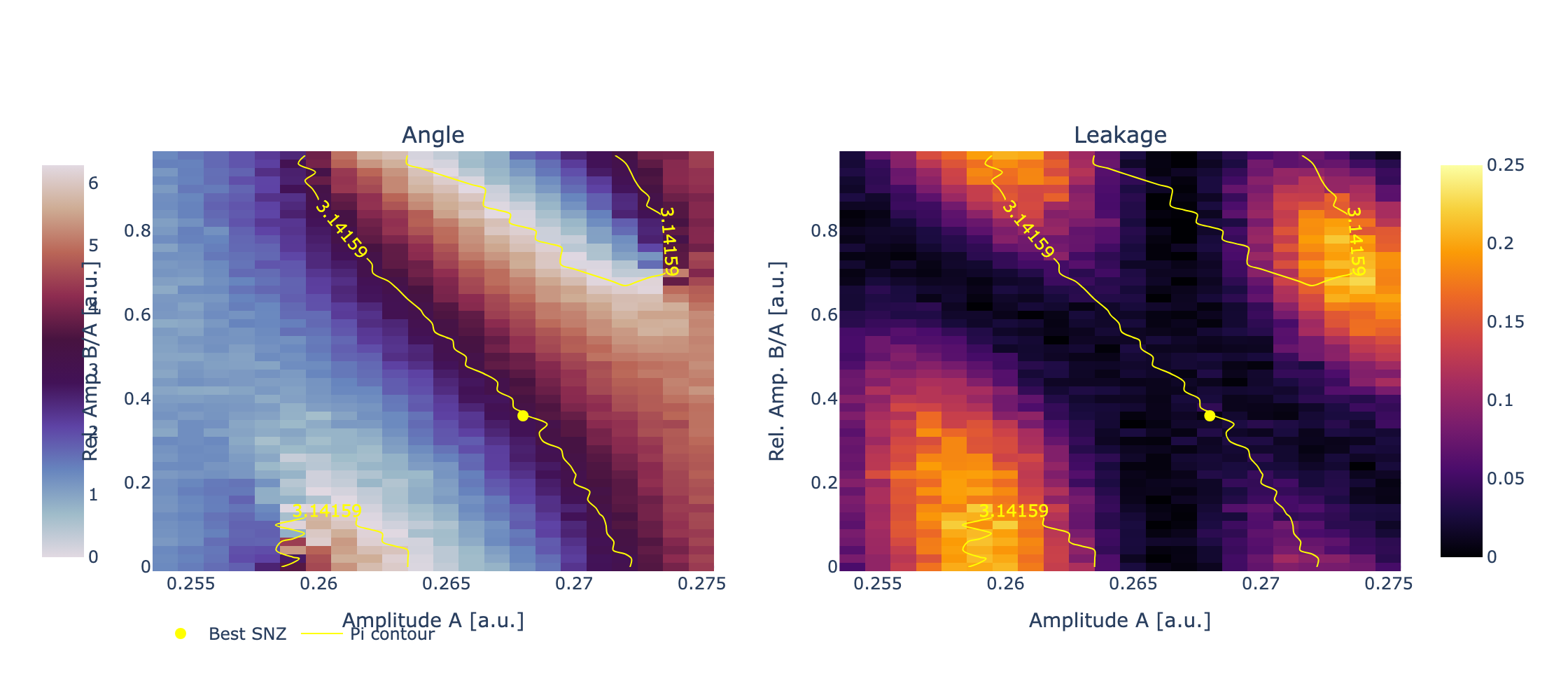
The resulting landscape is regular: leakage shows a vertical valley in \(A\), at the \(\ket{11}\)-\(\ket{02}\) resonance, and a diagonal one, and \(\phi_{CZ} = \pi\) is met where they cross. This is shown below for a measured \((A, B/A)\) landscape, with the conditional phase (left), the leakage (right), the \(\phi_{CZ} = \pi\) contour and the selected point.
A good CZ is therefore found with a two-dimensional search, provided by two protocols:
snz_optimizesweeps \(A\) and \(B/A\) at fixed \(t_\text{idle}\);snz_optimize_t_idlesweeps \(A\) and \(t_\text{idle}\) at fixed \(B/A\).
At each grid point the Virtual Z experiment is run, with the control qubit
in \(\ket{0}\) (I) or \(\ket{1}\) (X). The conditional phase is the
phase difference of the two fitted oscillations, and the leakage is estimated as
half the increase of the control excited-state population from I to X
[29]. The selected point is the one with the lowest leakage among those
with \(\phi_{CZ}\) within 10% of \(\pi\); if none exists, no update is
performed.
A typical workflow is Chevron to locate the
\(\ket{11} \leftrightarrow \ket{02}\) interaction, then snz_optimize, then
Virtual Z to calibrate the single-qubit phase corrections.
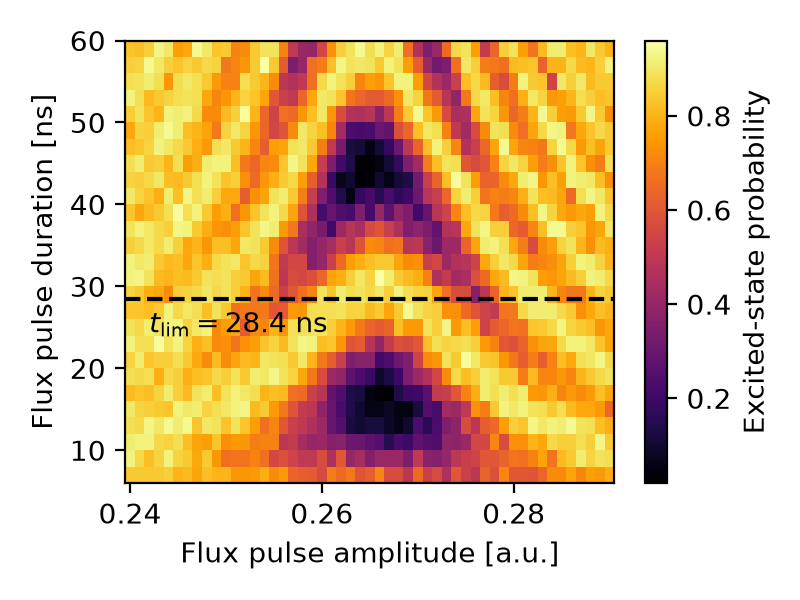
The gate time \(t_p\) should not be shorter than the speed limit \(t_\text{lim}\), the period of the on-resonance Chevron oscillation. Below it, the minimum leakage at \(\phi_{CZ} = \pi\) increases. An example of a measured chevron, with the extracted \(t_\text{lim}\), is shown below.
Note
The CZ native must contain a single flux pulse, on the higher-frequency qubit,
as its first element, e.g. for the pair (2, 4):
"4-2": {
  "CZ": [
    ["4/flux", {"kind": "pulse", "duration": 32.0, "amplitude": 0.268,
                "envelope": {"kind": "snz", "t_idling": 4, "b_amplitude": 0.36}}]
  ]
}
Further elements (e.g. virtual Z phases) may follow and are left untouched. Flux pulses on both qubits, split flux pulses or tunable-coupler pulses are not supported.
SNZ amplitude optimization
Sweeps \(A\) and \(B/A\) at fixed \(t_\text{idle}\) and \(t_p\).
- class qibocal.protocols.two_qubit_interaction.snz_optimize.SNZFinetuningParamteters(amplitude_min: float, amplitude_max: float, amplitude_step: float, amp_ratio_min: float, amp_ratio_max: float, amp_ratio_step: float, theta_start: float, theta_end: float, theta_step: float, t_idling: float, tp: float, flux_time_delay: float = 0)[source]
- amplitude_min: float
Amplitude minimum.
- amplitude_max: float
Amplitude maximum.
- amplitude_step: float
Amplitude step.
- amp_ratio_min: float
Minimum amplitude ratio of the two SNZ amplitudes
- amp_ratio_max: float
Maximum amplitude ratio of the two SNZ amplitudes
- amp_ratio_step: float
Amplitude ratio step of the two SNZ amplitudes
- theta_start: float
Virtual phase start angle.
- theta_end: float
Virtual phase end angle.
- theta_step: float
Virtual phase stop angle.
- t_idling: float
SNZ idling time, in number of steps.
- tp: float
Gate time.
- flux_time_delay: float = 0
Wait time after flux pulse.
- property theta_range: ndarray
- property amplitude_range: ndarray
- property amplitude_ratio_range: ndarray
- nshots: int
Number of executions on hardware.
- relaxation_time: float
Wait time for the qubit to decohere back to the ground state.
- id: snz_optimize
  operation: snz_optimize
  targets: [[2, 4]]
  parameters:
    amplitude_min: 0.254
    amplitude_max: 0.275
    amplitude_step: 0.001
    amp_ratio_min: 0.0
    amp_ratio_max: 1.0
    amp_ratio_step: 0.02
    theta_start: 0
    theta_end: 6.0
    theta_step: 1.0
    t_idling: 4
    tp: 32
    nshots: 100
The output is a landscape like the one shown above. The update sets the CZ flux
pulse to an SNZ envelope with the optimal amplitude and b_amplitude.
SNZ idling time optimization
Sweeps \(A\) and \(t_\text{idle}\) (in samples) at fixed \(B/A\) and \(t_p\).
- class qibocal.protocols.two_qubit_interaction.snz_optimize_t_idle.SNZIdlingParameters(amplitude_min: float, amplitude_max: float, amplitude_step: float, t_idle_min: float, t_idle_max: float, t_idle_step: float, tp: float, theta_start: float, theta_end: float, theta_step: float, b_amplitude: float)[source]
- amplitude_min: float
Amplitude minimum.
- amplitude_max: float
Amplitude maximum.
- amplitude_step: float
Amplitude step.
- t_idle_min: float
Amplitude minimum.
- t_idle_max: float
Amplitude maximum.
- t_idle_step: float
Amplitude step.
- tp: float
Gate time.
- theta_start: float
Virtual phase start angle.
- theta_end: float
Virtual phase end angle.
- theta_step: float
Virtual phase stop angle.
- b_amplitude: float
SNZ B amplitude.
- property theta_range: ndarray
- property amplitude_range: ndarray
- property t_idle_range: ndarray
- nshots: int
Number of executions on hardware.
- relaxation_time: float
Wait time for the qubit to decohere back to the ground state.
- id: snz_optimize_t_idle
  operation: snz_optimize_t_idle
  targets: [[2, 4]]
  parameters:
    amplitude_min: 0.254
    amplitude_max: 0.275
    amplitude_step: 0.001
    t_idle_min: 0
    t_idle_max: 10
    t_idle_step: 1
    b_amplitude: 0.36
    theta_start: 0
    theta_end: 6.0
    theta_step: 1.0
    tp: 32
    nshots: 100
The report has the same layout, with \(t_\text{idle}\) (ns) on the y axis. The
update sets the optimal amplitude and t_idling.