DRAG experiments
In this section we show how to run DRAG experiments using Qibocal
DRAG [7, 18]: pulses can be used to lower both phase and leakage errors. It consists of adding a quadrature component to the pulse which is proportional to the time derivative of the in-phase component. Given a pulse with an in-phase component \(\Omega_x\) the quadrature component \(\Omega_y\) is evaluated as
where \(\beta\) is a scaling parameter.
Qibocal provides two separate protocols to calibrate \(\beta\).
Method 1
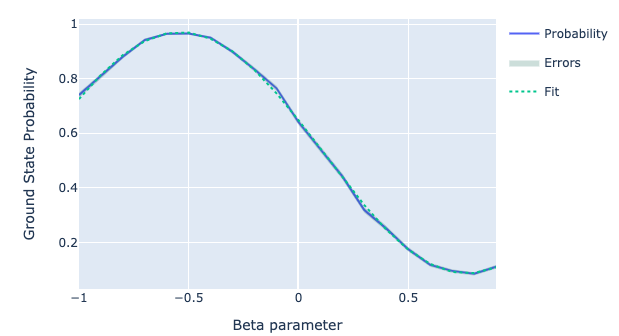
\(\beta\) can be extracted by playing the pulse sequence composed of \([R_X(\pi) - R_X(-\pi)]^N\) for different values of \(\beta\) as shown in [27]. The post-processing consists of measuring the probability of \(\ket{0}\) for every \(\beta\) and fitting the curve with a cosine. The correct \(\beta\) value is the one which maximizes the curve.
Parameters
- class qibocal.protocols.drag.drag.DragTuningParameters(beta: tuple[float, float, float] | None = None, beta_start: float | None = None, beta_end: float | None = None, beta_step: float | None = None, nflips: int = 1)[source]
DragTuning runcard inputs.
- beta: tuple[float, float, float] | None = None
(start, stop, step).
- Type:
Tuple of the beta parameters in the form
- nflips: int = 1
Repetitions of (Xpi - Xmpi).
- property beta_range: tuple[float, float, float]
Return a tuple with the beta sweep (start, end, step).
- nshots: int
Number of executions on hardware.
- relaxation_time: float
Wait time for the qubit to decohere back to the ground state.
Example
- id: drag tuning
  operation: drag_tuning
  parameters:
      beta_start: -1
      beta_end: 1
      beta_step: 0.1
      nflips: 5
Running this protocol you should get something like this:
Method 2
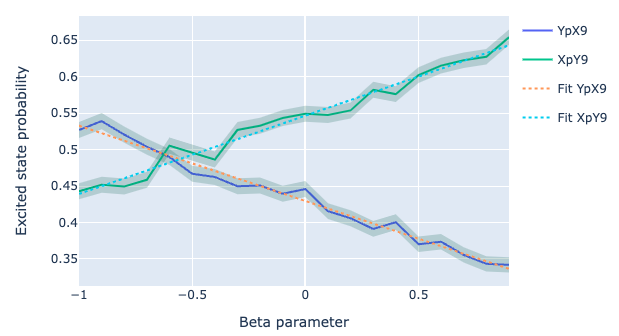
The second method consists of playing two different sequences \(R_Y(\pi) R_X(\pi/2)\) and \(R_X(\pi) R_Y(\pi/2)\). These are two of the AllXY sequences which exhibit opposite sign of phase error as highlighted in [24]. The post-processing consists of measuring the probability of \(\ket{1}\) for every \(\beta\) and performing a linear fit for both sequences. The correct \(\beta\) value is the one where the two lines cross.
Parameters
- class qibocal.protocols.drag.drag_simple.DragTuningSimpleParameters(beta: tuple[float, float, float] | None = None, beta_start: float | None = None, beta_end: float | None = None, beta_step: float | None = None, nflips: int = 1)[source]
DragTuningSimple runcard inputs.
- beta: tuple[float, float, float] | None = None
(start, stop, step).
- Type:
Tuple of the beta parameters in the form
- property beta_range: tuple[float, float, float]
Return a tuple with the beta sweep (start, end, step).
- nflips: int = 1
Repetitions of (Xpi - Xmpi).
- nshots: int
Number of executions on hardware.
- relaxation_time: float
Wait time for the qubit to decohere back to the ground state.
Example
- id: drag simple
  operation: drag_simple
  parameters:
      beta_start: -1
      beta_end: 1
      beta_step: 0.1